
The value of freedom in experimentation
In independent work, where there are fewer restrictions and no compliance frameworks to navigate, the impact of AI is most visible. I built a project tracker that uses a node-based visual style, not as a new technology in itself, but simply as a way of representing complexity that aligns with how I think about dependencies. For years, this idea remained on paper. With Lovable, I had a working prototype in minutes. That kind of speed and flexibility demonstrates how much potential is lost in environments where experimentation is slowed by process.
The deliberate pace of enterprise adoption
Within larger organisations, the emphasis shifts. Tools are only approved once they satisfy governance and compliance standards. This caution is entirely rational: the risks to brand and business continuity are significant. Yet the outcome is predictable, enterprise change remains linear in pace, while AI progresses at something closer to an exponential curve. The result is a widening gap between what is technically possible and what can be delivered internally.
The importance of prompt precision and frameworks
AI prototyping removes weeks of initial effort: hosting, schema design, APIs, user interfaces, all generated in a fraction of the time. However, there is a cost. Each poorly constructed prompt consumes resources and time. This elevates prompt engineering from a matter of creativity to one of economic efficiency. Organisations that establish frameworks for writing, testing, and refining prompts will secure a competitive advantage. In the same way that coding literacy became a core skill in the last generation of technology, prompt literacy will become central in the next.
Governance and compliance as necessary, but not sufficient
Data governance and compliance are pressing concerns today, and significant investment will flow into solving them. Yet they are not the ultimate barrier. The deeper strategic question is how organisations choose to respond to the capacity unlocked by AI. Some will see it as an opportunity to expand output and pursue new opportunities. Others will treat it as primarily a tool for reducing headcount. These choices will shape organisational culture and long-term outcomes more than the technical governance itself.
The evolution of change management
As delivery accelerates under the influence of AI, the potential for error increases at the same pace. Safeguards such as automated testing and secure pipelines are no longer optional extras, they are essential. At the same time, these controls cannot themselves create delay. Change management must become as automated as the systems it seeks to protect. The challenge is to balance speed with security, so that neither overwhelms the other.
Skills for the next phase of development
The role of the developer is shifting. It is no longer simply about writing code, but about shaping context, guiding the model, and knowing when to trust or correct its output. Those with experience in software engineering prior to the AI wave retain a particular advantage, especially in areas such as debugging where AI still struggles. Yet the greater skill lies not in reacting to today’s tools, but in anticipating where the technology will be tomorrow and positioning accordingly.
Closing reflection
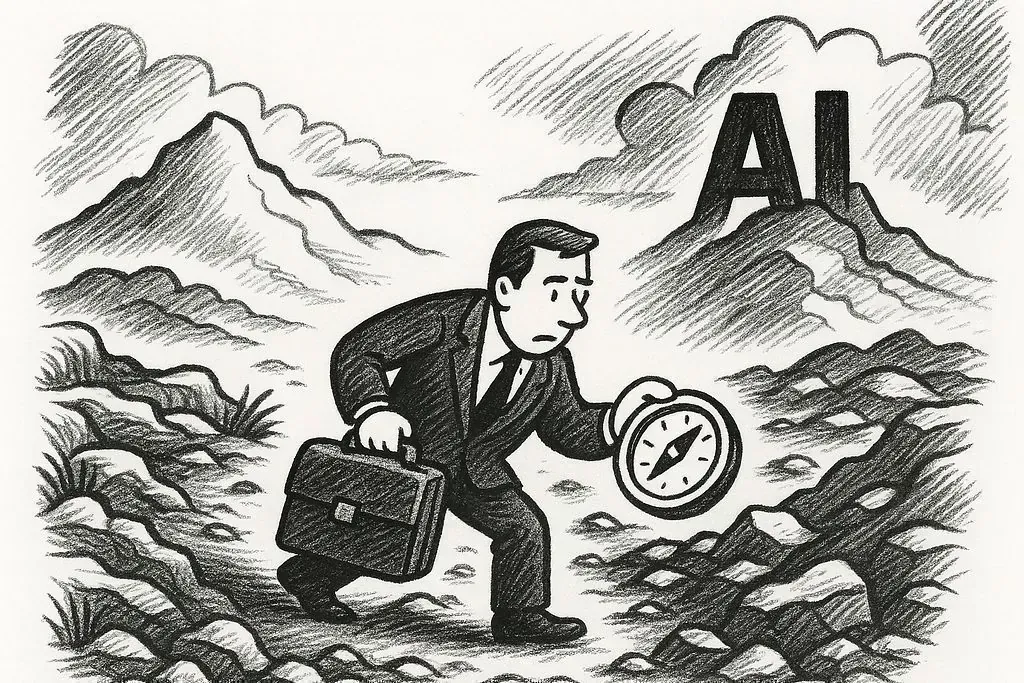
The development of AI is moving at a pace unmatched by the ability of most organisations to adapt. Those who succeed will not necessarily be the ones with access to the most advanced models, but the ones who are able to rework their governance, their decision-making, and their workforce skills to make effective use of them.
The technology has already arrived. The real challenge is whether we can develop the capacity to change at the speed that is now required.
Also on Medium