
Executive summary
I address that with two coupled habits that must read as one system: a pipeline that moves an idea from capture to a live release with evidence attached, and a weekly scorecard that compares hours logged to the menu I set at the start of the week. Without that coupling, the most visible signal in the room steers the calendar.
On memeinstants.com I spent several hours chasing Lighthouse performance scores while a learning goal existed only as an intention; professional development dropped off the week, and the dashboard never complained. On listing automation, validating energy-performance certificate data against the official register had no partner shouting for it, and it moved forward because the planning system kept it visible. I proved the pipeline end to end on a small listing change with measurable traffic. The scarce resource is steering.
Business insights
Orientation tells you what deserves attention across a portfolio; execution tells you what actually moved. I am the only one holding the thread across those bets, and I need a log I can trust mid-week.
Good ideas die when capture never becomes a shippable path
When capture, planning, build, and release live in different places with no enforced handoff, I reopen context every session and confuse motion with progress. The fix is a single home for each stage and a definition of done the environment can verify. I split roles deliberately: the vault holds outcome descriptions and methodology; Linear holds status, due dates, and blockers. Maintaining shippable todos in both places drifted within days.
The calendar follows whatever surfaced last unless you judge the week on purpose
Inbox noise, client urgency, a dashboard turning amber, and open-ended agent chat compete for the same hours, and none of them knows my portfolio menu. What reaches me with the least friction tends to consume the calendar first, not because it ranks on the portfolio but because it was easy to interrupt. The easier I am to reach, the less my hours tend to be valued when the week is reviewed, which is the opposite of what an always-on inbox promises. The scorecard answers a simpler question than productivity: did the bets I said matter receive time and a shippable result? Weeks with strong automation but zero learning time failed on review; weeks with one shipped asset passed even when they felt less busy.
Automation should surface and propose; ship authority stays human
Agents can classify, score, and draft, but production risk, architecture, and what counts as done are judgements I retain. Scoped loops beat open chat for the same reason a ticket beats a wandering conversation: a bounded job with acceptance criteria can finish, while chat without an end state consumes the week.
When capture-to-ship stages each have a home and a weekly scorecard surfaces hours against intent, portfolio throughput rises because judgement compounds from evidence rather than from whatever interrupted you last.
How the execution layer works
The vault is for judgement and logs; the task tracker is for ship status; agents run from markdown runbooks on a schedule.
Vault thinks, Linear ships
Each active venture has a finish line in prose inside the vault. Linear issues are the steps toward it. Heavy reports live on a doc site I own; the vault holds indexes and links. I never duplicate shippable todos across both places.
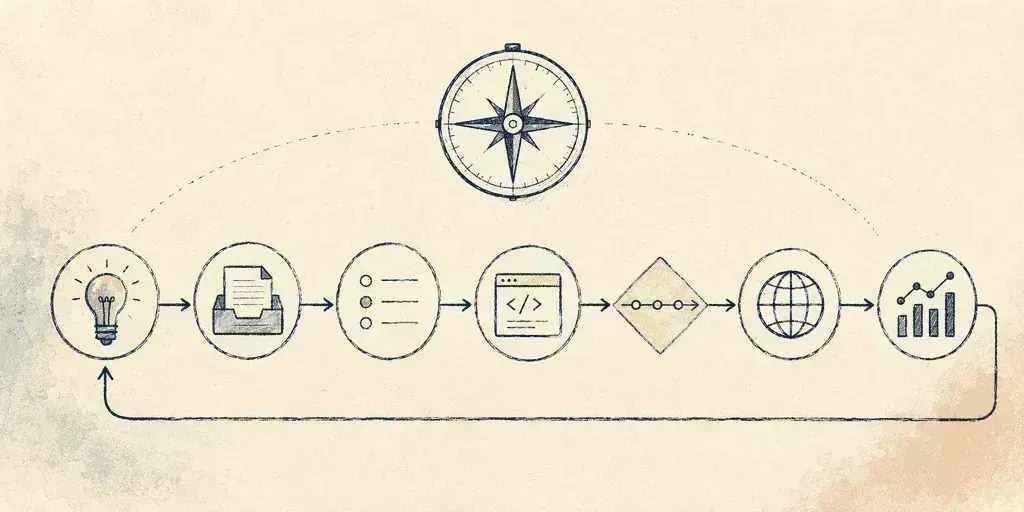
The capture-to-ship loop
Work moves in a loop. Each stage has a home; ship authority stays mine.
flowchart TB
  subgraph capture [Capture]
    A[Notice signal or idea]
    B[Drop into mobile inbox]
  end

  subgraph pipeline [Pipeline]
    C[Classify and score]
    D[Plan in week file]
    E[Build in repo]
    F[Deploy to production]
    G[Put release or report live]
  end

  subgraph loop [Measure]
    H[Read traffic and log hours]
  end

  subgraph gates [Human approval]
    G1[Approve architecture change]
    G2[Review code before ship]
  end

  A --> B --> C --> D --> E
  E --> G2
  G2 --> F --> G --> H
  H -->|new signals| B
  C -.-> G1
Ideas land in a mobile inbox and get classified on a schedule. Planning sets hour budgets by venture and a running log; the day plan locks three to five outcomes before code. Measurement uses search traffic, hours logged, and a Monday scorecard review.
Automation routes, scores, and proposes, but I retain judgement on production risk, architecture, and what goes live. Agent work runs as loops with acceptance criteria, not open chat.
How I steer a week without a chief of staff
The pipeline moves work; the scorecard judges the week. Weekboard holds hour budgets, open tasks by venture, and a running log. Dayboard locks today's outcomes before code. The review question: did those four bets receive allocated time, and did at least one ship with evidence?
Mid-week I trust ticket deltas over narrative: opened versus closed in the task tracker, grouped by venture. Twelve opened and four closed across four projects is capture outpacing ship; five closed on listing automation while the app bet stays deliberately open is steering.
Week A felt productive and failed; Week B felt less busy and passed. Without that review I would remember Week A as a win.
Runbook shapes you can copy
Classify before you act: for each inbox line, decide task, reference, or idea; add one sentence of context and a link; estimate value before it enters a tracker; queue genuinely ambiguous items for a human choice.
Lock the day before the code: three to five shippable outcomes for today, not topics; read the calendar first and treat fixed appointments as blocked time; work one active item at a time after that.
Done means evidence, not status: every agent job needs a done-when the environment can check; report pass, fail, or blocked with observable output.
Judge the week on three signals: did the bet ship, did I wander off the menu, did hours match the budgets I set?
What I can share without exposing the vault
Partners rarely need folder names; they need proof that calendar time matched portfolio intent. I can share runbook shapes like the ones above, the scorecard as a weekly trace (hours against bets, not a productivity flex), and the abstract capture-to-ship flow from the diagram. Heavy artefacts go on a doc site I own; essays hold the capital narrative. What stays private: the raw inbox, archive graveyard, client ticket detail, partner names, and anything that would leak credentials or funnel specifics.
Conclusion
After orientation, I still knew the work. The failure mode was execution being steered by whatever surfaced last: a glowing Lighthouse dashboard, client noise, or an agent session with no definition of done.
The direction that held is an execution layer with a pipeline and a scorecard, not a better inbox: one home per stage, scheduled readouts instead of chat-only context, human approval on what goes live, and a weekly review against portfolio intent rather than how busy it felt.
That is the capability worth rebuilding: movement with evidence, and judgement that survives when nobody else holds the thread.
Agent skills for capture
Earlier in this essay I described capture as the front of the pipeline: inbox lines that have to become tasks, ideas, or reference before they can earn a place in the week. I use an agent skill called ingest for that step. The version I run day to day is tightly wired into my own vault layout and task tracker, so it would not travel well as published advice. The copy on rowanarcher.com/writing/skills/#ingest is the generic flow I would hand someone else first: take provisional lines, enrich them, classify them, ask when the destination is unclear, and only create calendar work when the raw text actually asks for a date.
That shared version is a beginning, not a finished system. Someone else would improve it by plugging in the tools they already trust: calendar MCPs for confirmed commitments, connectors to their own notes or project data, stricter scoring rules for what is allowed to become a ticket, or routing tables that match their portfolio rather than mine. The useful pattern stays the same; the integrations are where it becomes theirs.
Previous: Part 1 - A Second Brain That Survives a Solo Founder Week · Next: Part 3 - Continuous Improvement That Survives a Solo Founder Week · All articles