
Let me preface this with the context that ChatGPT is rapidly changing, and often unavailable even to Plus members, due to it being the fastest-growing digital service of all time. I’m aiming to make these points as valuable as possible to any prompt-based Large Language Model (LLM).
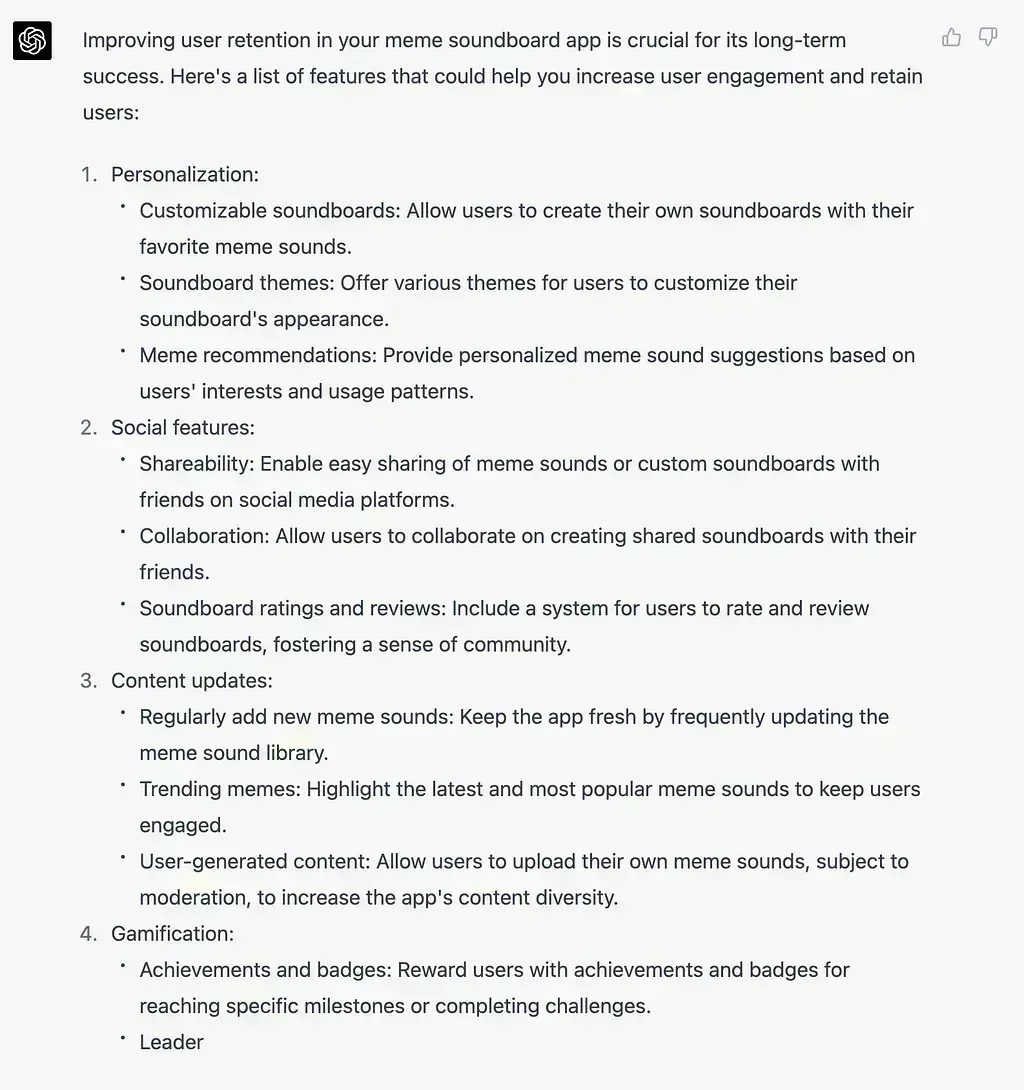
Prompt 1: “help me create a feature list to improve user retention in my meme soundboard app”
Output Analysis
- ChatGPT correctly guessed the context of the app including an expected feature set of a Meme Soundboard app, which is helpful since I didn’t need to provide the context of the current feature set for it to suggest improvements.
- The suggested features are groups under headings (e.g. Push notifications and reminders), with a breakdown of specific features which is useful for readability. GPT3.5 does not structure its response as clearly as GPT4 (see below)

Prompt Tips
- Refining the prompt to be more specific and actionable, e.g. instead of “improve user retention,” you could ask, “What features can I add to my meme soundboard app to increase user engagement and reduce user churn rate?” This can help ensure that the features you add are relevant and useful to your target audience.
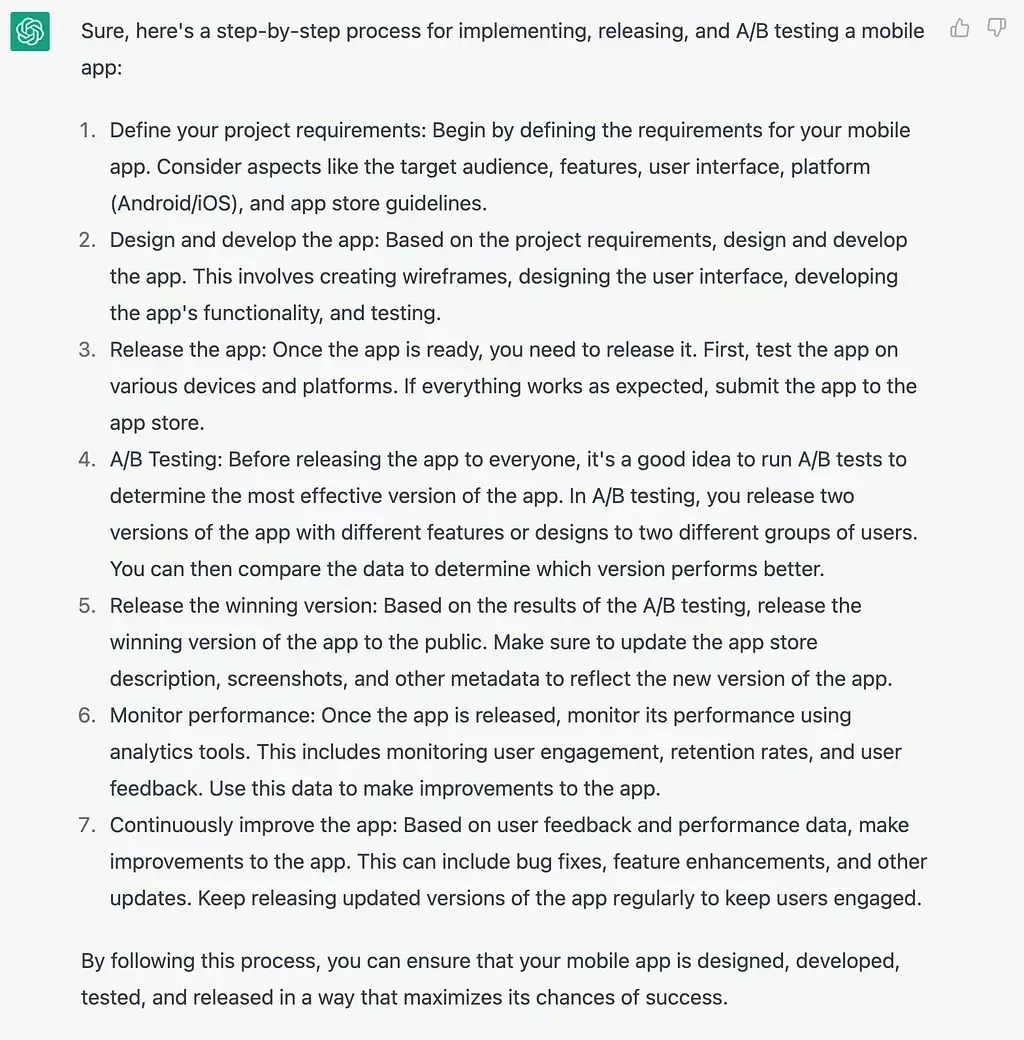
Prompt 2: “Design a step-by-step process for implementing, releasing, and A/B testing with the context of software engineering tasks for a mobile app”
Output Analysis
- This response demonstrates that even with broader queries related to abstract processes, the response is comprehensive and capable. For the specific circumstances of your product, e.g. A/B testing on a specific platform with X requirements, it is possible to quickly build a custom process that is relatively robust and follows best practices.
Prompt Tips
- When asked for feedback on the prompt, ChatGPT explains that the greater the specificity of the request, the greater the accuracy of the response. This has become a standard workflow I use for engaging the tool now: initial request (as detailed as possible) asks for broad deliverables, then subsequent prompts request iteration and provide additional context on specific parts. After discussing the desired changes, it is possible to request the full response is recreated again.
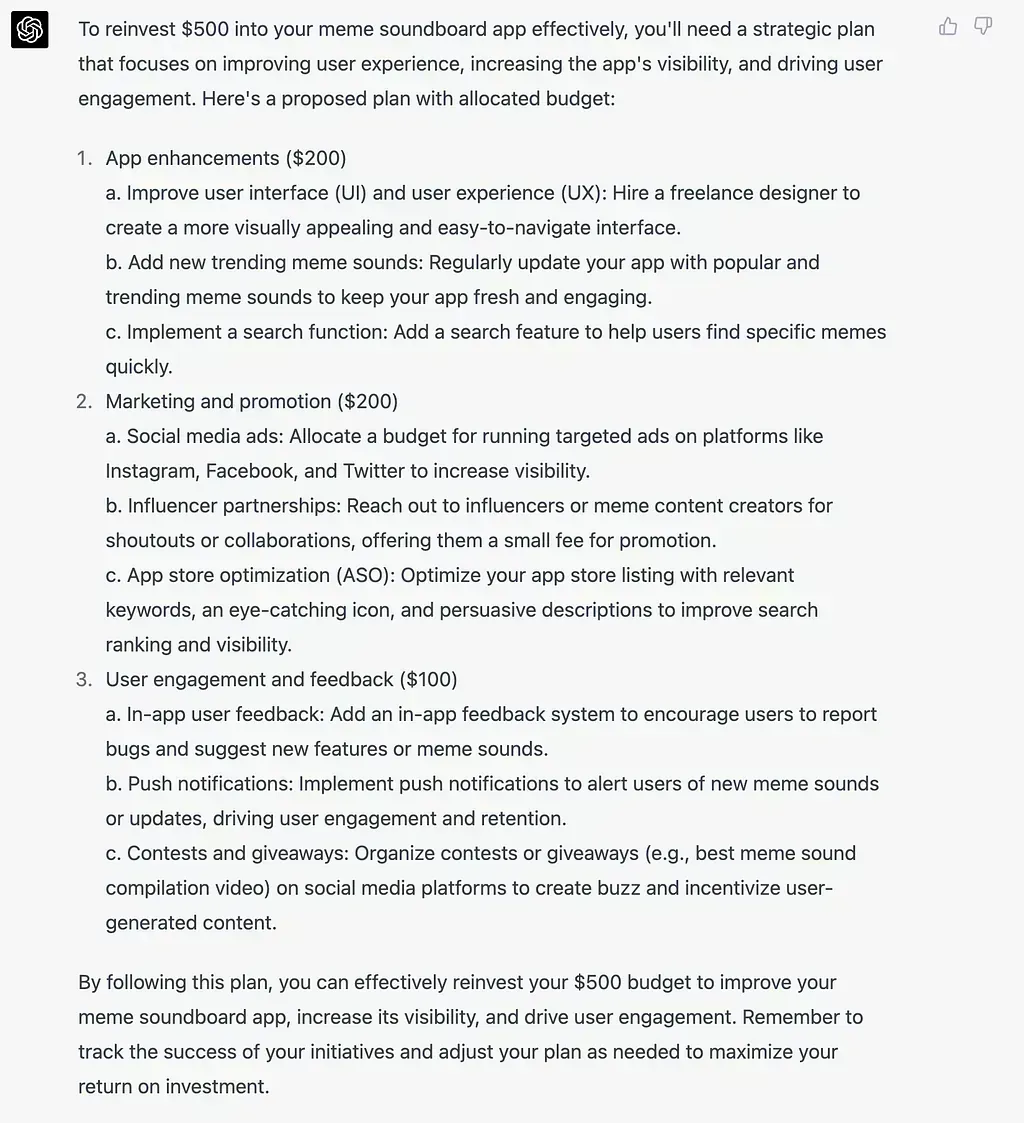
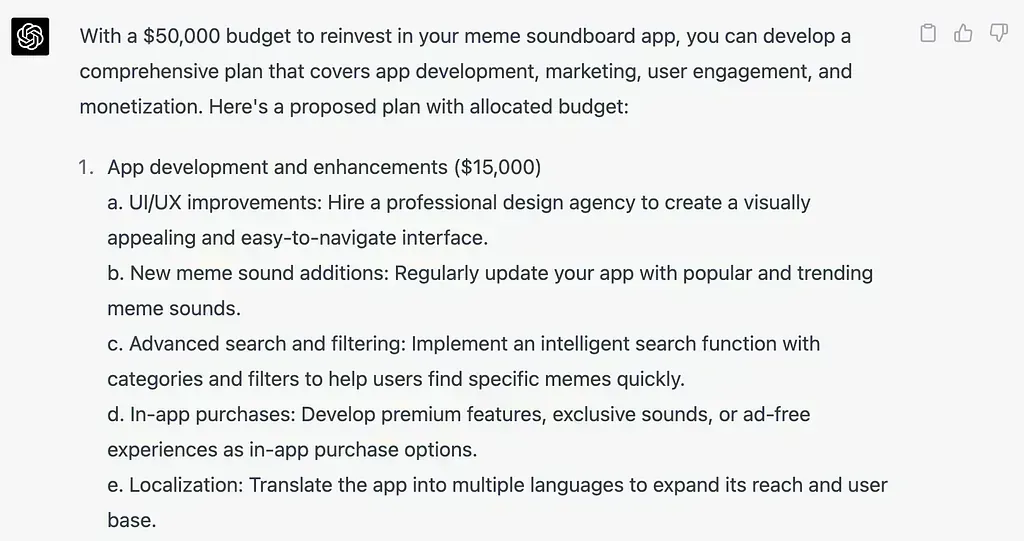
Prompt 3: “I have $500 to reinvest in my meme soundboard app. Make a plan.”
Output Analysis
- This budget-based prompt pushes ChatGPT on one of its weakest skills: up-to-date market realities. I think it would reckless to follow these instructions without introducing additional decision-making. I have low confidence that the proposed budget allocation would cover the suggested features, and the suggestions could potentially be a very poor return on investment without additional market research.
- It seems like if I had assigned a larger budget, it would have allocated it on the balance of priority proportionally between the categories, and at a larger scale this could actually make sense. With a 10x budget ($50,000), it is interesting that the strategy actually changes though, introducing delegation of tasks to specialists and adding a greater scope - rather than just changing allocation amounts as I suspected.
Prompt Tips
- Prompt specificity is not great, not giving detail on the desired outcome makes it challenging to provide anything other than an overall balanced strategy.
- Building a targeted custom strategy towards defined goals would result in exploiting the more valuable side of ChatGPT since this would be something that couldn’t be found in off-the-shelf guides.
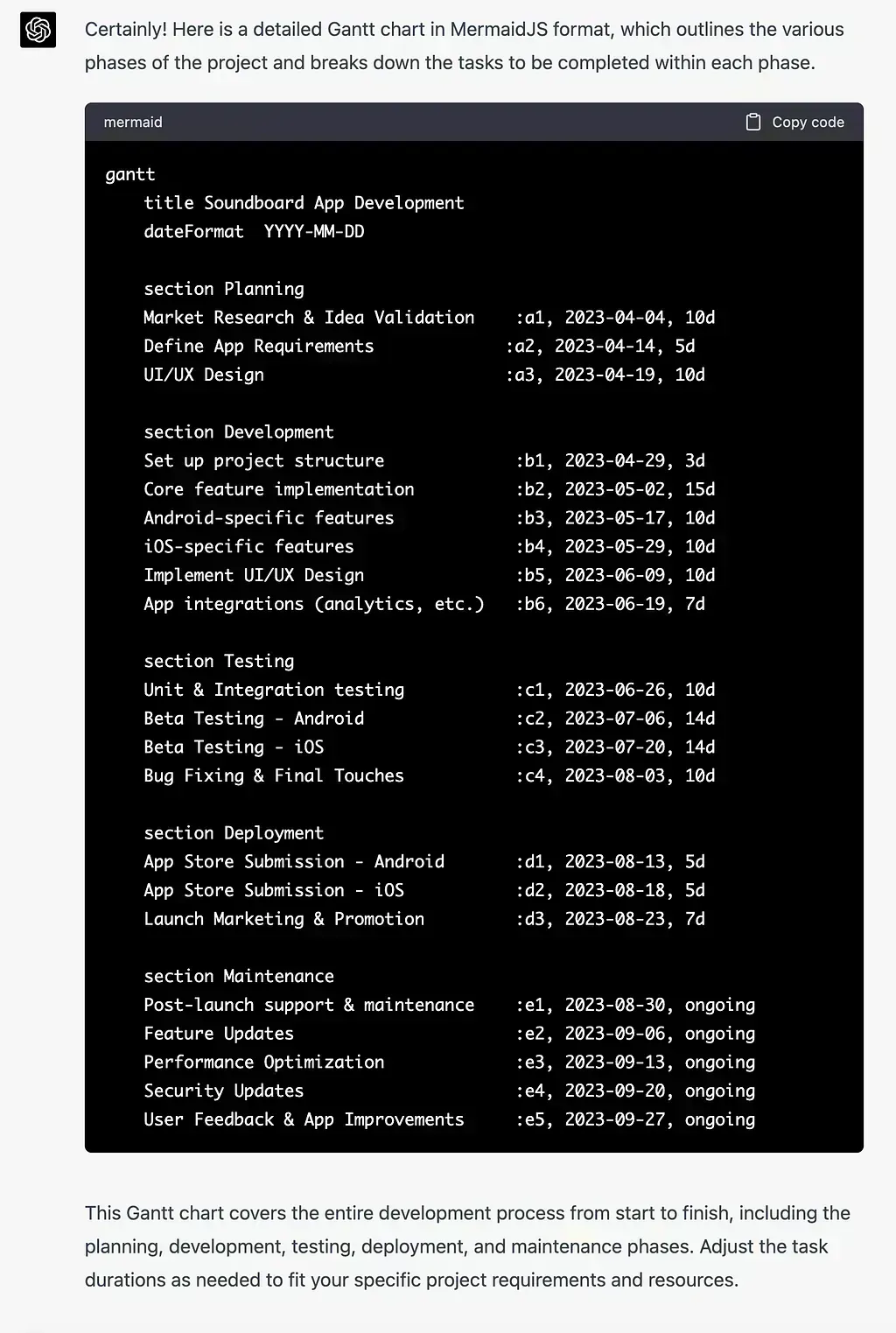
Prompt 4: “I’m interested in developing a soundboard app that will be released on both iOS and Android. Could you please create a Gantt chart in MermaidJS format that outlines the features that need to be developed, and the timeline for completing each task? The chart should cover the entire development process, from start to finish. I’m looking for a detailed breakdown of each section, including planning, development, testing, deployment, and maintenance?”
Output Analysis
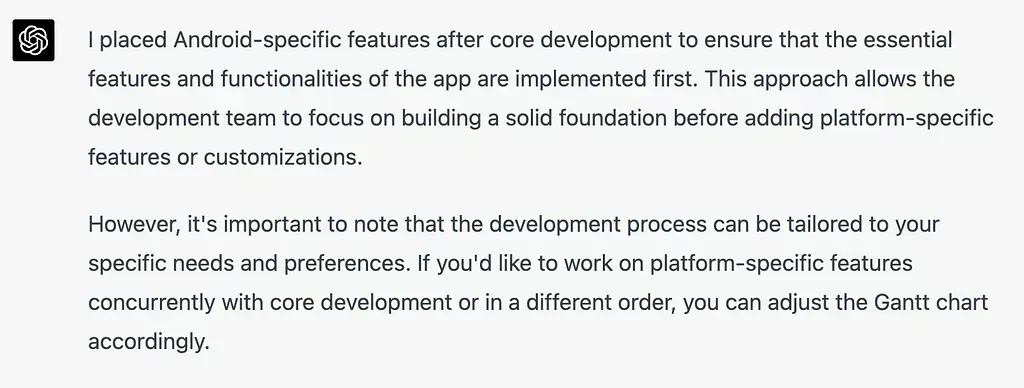
- The Gantt chart ordering and overlaps clearly indicate that the model has used reasoning to form the proposed structure. This reasoning can be questioned, which allows you to pick at the decision-making process for assumptions and bias, and alter it to suit your ways of working.
Prompt Tips
- Combining a request for specific fields and format, e.g. A Gantt chart in MermaidJS that outlines features and timelines for each task, can provide a powerful output that needs no further action to become useful (aside from pasting into a viewer such as https://tasks.techtr.ee/)

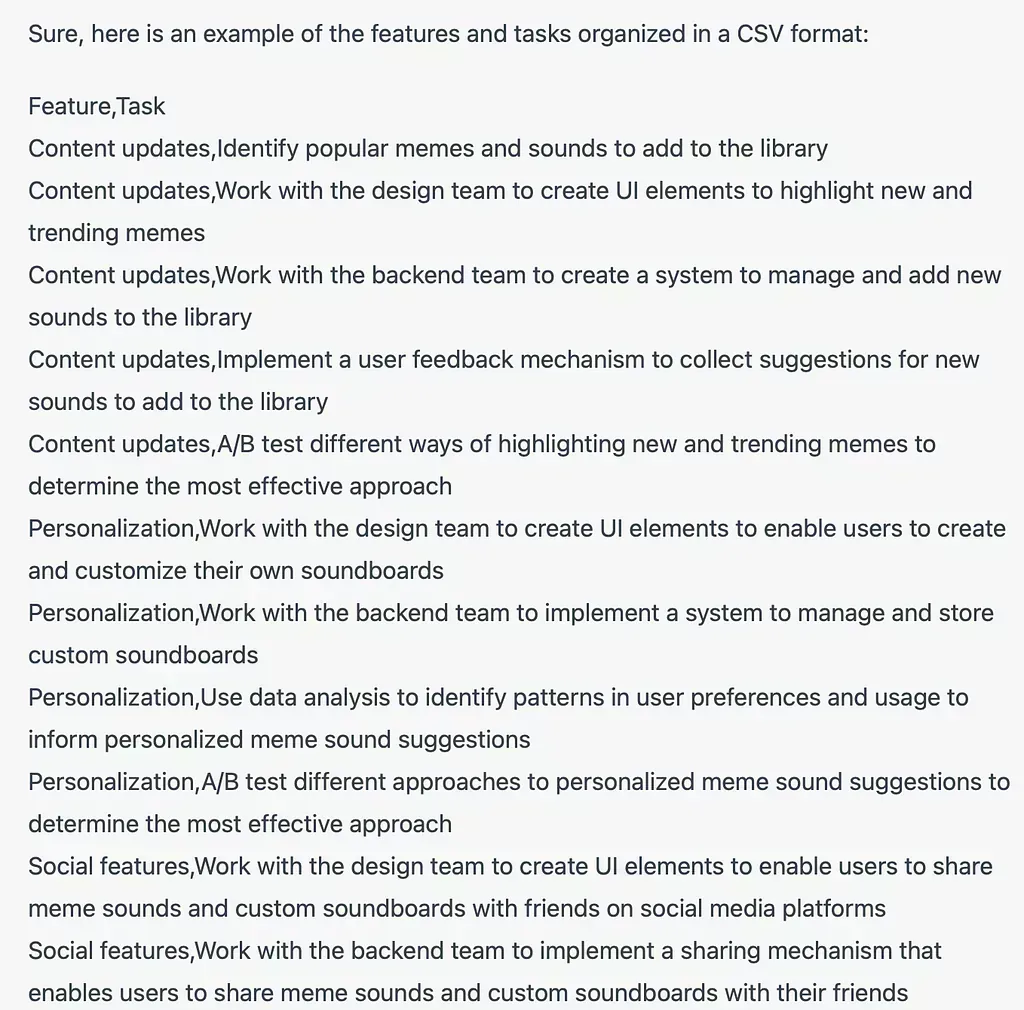
Prompt 5: “Act as a product manager. This is the product description: {Play Store Description}. Based on the information provided, here are some key steps that I would take as a product manager to ensure the success of the product. Prioritize this product backlog in order of estimated added value vs scope/effort. please outline a process to take each of these points from start to finish (including A/B testing features to determine effectiveness). I need to be able to give them to an engineer as tasks, so break these down into individual tasks with a title, description, acceptance criteria, and estimated time to complete in hours. Output this as a CSV.”
Output Analysis
- This list was useful to outline tasks that could be provided to a team.
- For vague areas like ‘A/B test different approaches’, it's possible to just query further, and I asked for specific tests and parameters for determining success, which were then provided.
- It is easy to load a task out of this list, and immediately enter it back into ChatGPT to assist with the next layer of actually implementing the tasks too.
Prompt Tips
- It assumed access to a specific set of skilled teams, so this could have been specified to tailor the output
- Specifying a format like CSV is helpful since the input/output options for ChatGPT are currently limited.
- If you think a specific response is too complex for a given audience (e.g. super technical for a non-technical audience), request the response is re-written for a less technical audience or ‘ELI5–style’ for extreme simplification.
Summary
Using ChatGPT’s assistance, I was able to create a comprehensive feature list, sign a step-by-step process for implementation and A/B testing, act as a product manager, and create a monetization plan with a limited budget for my app.
The balanced responses were available with no dependency on external teams and felt collaborative and positive.
The future of business strategy seems like it will become AI-supported in the same way that it is currently Search-Engine supported.
,
Bonus Tip (Recursion!)
Ask ChatGPT to improve your prompting by adding the following phrase to every prompt: ‘Add tips to improve prompt.’
,
Thanks for reading my post, check out our other projects at https://localhostlimited.com/works
Also on Medium